Birth Chart & Kundli
Mahadasha and Antardasha Explained: How Vedic Astrology Uses Planetary Periods
Mahadasha and Antardasha Explained: How Vedic Astrology Uses Planetary Periods
By AstraLife Editorial · · Updated
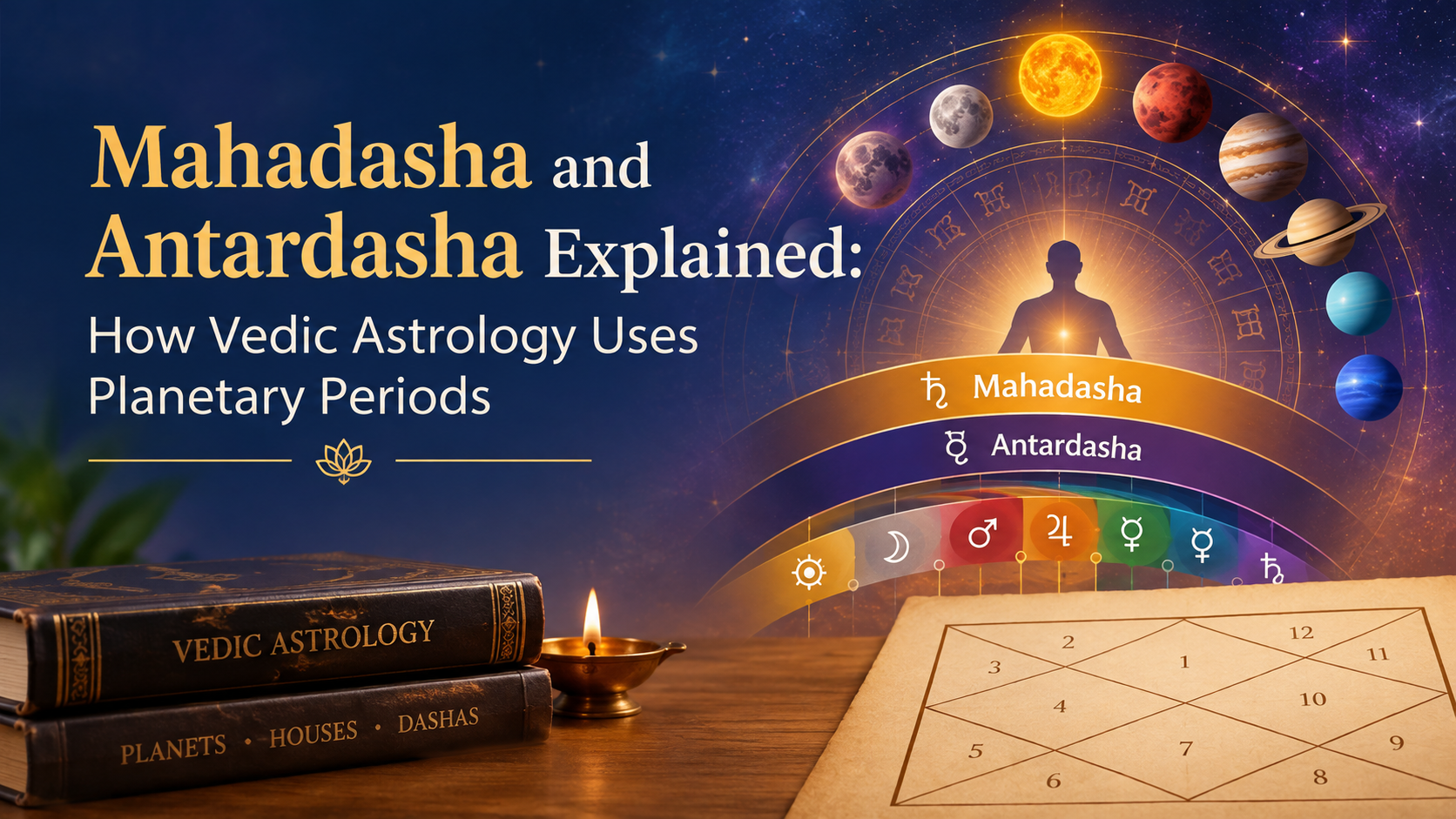
Mahadasha and Antardasha Explained: How Vedic Astrology Uses Planetary Periods
You can have a birth chart that promises immense career success or a deeply fulfilling marriage. But the most common question people ask is: When will it actually happen?
Having a strong planet in your chart is like owning a high-performance sports car. However, you cannot drive it until you are handed the keys. In Vedic astrology, the system that hands you those keys and dictates the timing of major life events is known as the Dasha system, primarily comprising your Mahadasha and Antardasha.
If you have ever felt your life shift dramatically almost overnight—where a quiet period suddenly turns chaotic, or a struggling career suddenly takes off—you likely experienced a shift in your planetary periods.
The Concept of Timing: What is a Dasha?
A birth chart is static; it never changes. A Dasha is dynamic; it is the moving timeline of your life.
The Dasha system operates on the principle that different planets take turns "ruling" your life for specific blocks of time. Depending on which planet is currently activated, you will experience the themes, lessons, and karmic results associated with that specific planet in your birth chart.
Mahadasha: The Major Planetary Period
The Mahadasha is the overarching, major planetary period. Think of it as the CEO of your life for a set number of years. The planet running your Mahadasha sets the broader theme, environment, and background music of your life.
If you are running a Jupiter Mahadasha, and Jupiter is well-placed in your chart, this period often brings a broad theme of expansion, learning, financial growth, and optimism. If you are running a Saturn Mahadasha, the overarching theme will be discipline, hard work, structural changes, and maturity.
Every person is born into a specific Mahadasha based on the exact degree of the Moon at their time of birth.
Antardasha: The Sub-Period (The Finer Details)
While the Mahadasha sets the major theme, it lasts for many years. Life does not stay exactly the same for a decade. This is where the Antardasha (sub-period) comes in.
If the Mahadasha is the CEO, the Antardasha is the mid-level manager executing daily tasks.
Every Mahadasha is broken down into smaller sub-periods ruled by the other planets. For example, during your 19-year Saturn Mahadasha, you will experience a Saturn-Mercury period, a Saturn-Venus period, a Saturn-Sun period, and so on.
The Mahadasha (Saturn): Demands hard work and sets a serious tone.
The Antardasha (Venus): Venus governs relationships and luxury.
The Result: During a Saturn-Venus period, you might work incredibly hard to save money for a wedding, or you might sign a strict legal contract (Saturn) to buy a luxury property (Venus).
The Vimshottari Dasha System (120-Year Cycle)
The most common and accurate timing system used in Vedic astrology is the Vimshottari Dasha system. In this system, the maximum human lifespan is considered to be 120 years, divided among the 9 planets.
Each planet rules for a fixed number of years:
Sun (Surya): 6 Years
Moon (Chandra): 10 Years
Mars (Mangal): 7 Years
Rahu (North Node): 18 Years
Jupiter (Guru): 16 Years
Saturn (Shani): 19 Years
Mercury (Budh): 17 Years
Ketu (South Node): 7 Years
Venus (Shukra): 20 Years
You do not start at the Sun and end at Venus. Your starting point is determined by your birth Nakshatra (your Moon sign's specific constellation). From there, you move through the periods in this exact sequential order.
How to Find Your Current Mahadasha and Antardasha
You do not need to memorize these cycles. The easiest way to find out which planetary period is currently running your life is to check your birth chart online.
By entering your exact birth details into a high-quality [INTERNAL LINK: Kundli / Birth Chart page], you can instantly pull up your personalized Dasha timeline. This will show you exactly when your current Mahadasha ends, which Antardasha you are in today, and what planetary shifts are coming in the future.
Conclusion
Understanding your Mahadasha and Antardasha provides immense clarity, transforming astrology from a collection of static traits into a dynamic timeline of personal growth. It reminds you that difficult phases carry specific lessons with a clear expiration date, while prosperous cycles reward past efforts. By tracking these planetary periods using a reliable [INTERNAL LINK: Astrology App page], you can better align your actions, prepare for life's transitions, and navigate your unique path with confidence.
Frequently Asked Questions (FAQs)
What is a Mahadasha? A Mahadasha is a major planetary time period in Vedic astrology. During this period, the ruling planet acts as the primary influence over your life events, environment, and general psychological state for a set number of years.
What is an Antardasha? An Antardasha is a sub-period within a Mahadasha. While the Mahadasha planet sets the broad theme of your life, the Antardasha planet triggers specific, short-term events and interactions.
How long do these planetary periods last? In the Vimshottari Dasha system, planetary periods last for a fixed number of years. For example, Venus lasts 20 years, Saturn lasts 19 years, Rahu lasts 18 years, and the Sun lasts 6 years.
Does a bad Mahadasha ruin everything? No. Even during a challenging Mahadasha, you will experience positive Antardashas (sub-periods) that bring relief, success, and happiness. Vedic astrology is cyclical, and no single period is entirely negative.
How do I find out my current Mahadasha? You can find your current Mahadasha by calculating your birth chart using your precise birth date, time, and location. The Dasha sequence is determined by the specific constellation (Nakshatra) your Moon was in when you were born.