Astrology Guides
How to Read Your Kundli: A Beginner's Guide to Birth Chart, Houses, Planets & Nakshatras
Looking at a traditional North Indian Kundli for the first time can feel like trying to decipher an ancient code.
By AstraLife Editorial · · Updated
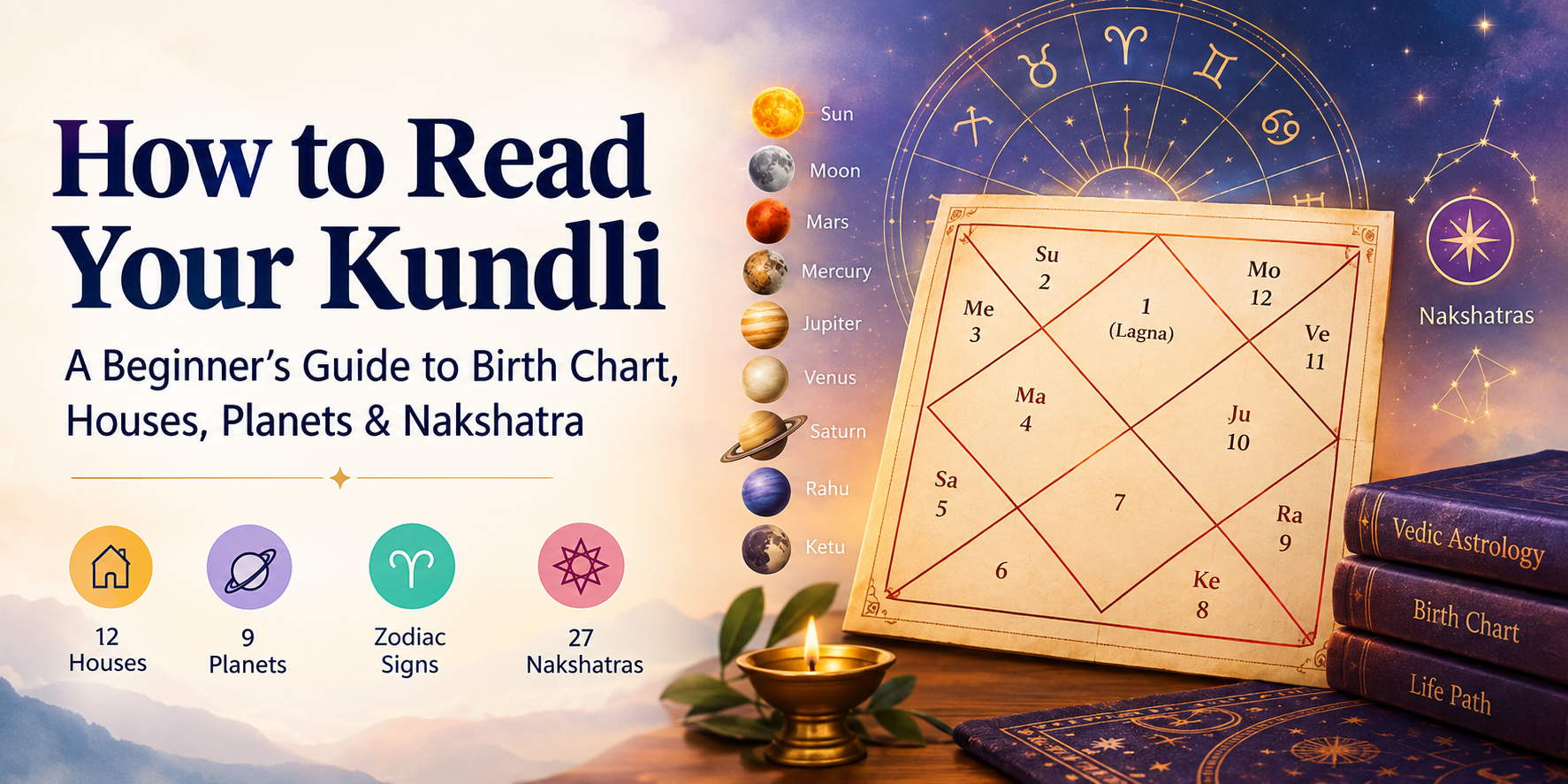
Looking at a traditional North Indian Kundli for the first time can feel like trying to decipher an ancient code. Grids, numbers, and abbreviated planet names scatter across a diamond-shaped chart. But reading a Kundli is essentially just reading a map of the sky at the exact moment you were born.
If you are wondering how to read your Kundli without feeling overwhelmed, the secret is breaking the chart down into its fundamental building blocks. In Vedic astrology, a birth chart is interpreted using planetary positions, zodiac signs, houses, and aspects to understand themes such as relationships, career, and personal tendencies.
Here is a step-by-step guide to decoding your birth chart.
What exactly is a Kundli?
A Kundli, or birth chart, is a mathematical snapshot of the heavens. When you input your exact date, time, and place of birth into a reliable platform—like the best astrology app you can find with an accurate ephemeris—the software calculates exactly where the planets were positioned relative to your birthplace.
The 4 Core Elements of Reading a Kundli
To understand your horoscope, you only need to familiarize yourself with four main variables:
Houses (Bhavas): The 12 fixed areas of your chart representing different areas of life (e.g., career, marriage, wealth).
Zodiac Signs (Rashis): The 12 constellations that act as the environment or "flavor" of the houses.
Planets (Grahas): The 9 celestial bodies that act as the characters driving the action.
Nakshatras: The 27 lunar mansions that add deep psychological context.
Step 1: Identify Your Ascendant (Lagna)
The first step in reading a North Indian style Kundli is looking at the top-center diamond. This is the 1st House.
The number written in this top-center diamond represents your Ascendant (Lagna) sign. The Ascendant is the zodiac sign that was rising on the eastern horizon when you were born.
If the number is 1, your Ascendant is Aries.
If the number is 2, your Ascendant is Taurus.
If the number is 7, your Ascendant is Libra.
Your Ascendant represents your physical body, your outward personality, and your general approach to life. It is the starting point of your entire chart.
Step 2: Understand the 12 Houses (Bhavas)
A Kundli has 12 houses. While the zodiac signs move around depending on your birth time, the physical position of the houses in a North Indian chart never changes. The top-center diamond is always the 1st house, and you count counter-clockwise.
Each house governs specific life themes:
House
Primary Life Themes Governed
1st House
Self, physical body, appearance, overall vitality
2nd House
Wealth, savings, speech, immediate family, food
3rd House
Courage, siblings, short travels, communication, skills
4th House
Mother, home, inner peace, properties, vehicles
5th House
Creativity, romance, children, intelligence, past-life karma
6th House
Debt, diseases, enemies, daily routine, service
7th House
Marriage, business partnerships, legal contracts
8th House
Longevity, sudden transformations, occult, inheritance
9th House
Luck, religion, father, higher education, long travel
10th House
Career, public reputation, authority, karma
11th House
Gains, large networks, elder siblings, fulfillment of desires
12th House
Expenses, foreign lands, isolation, spirituality, loss
When you look at your chart, notice which houses are filled with planets and which are empty. A house with multiple planets suggests that the themes of that house will be highly active in your life.
Step 3: Track the 9 Planets (Grahas)
In Vedic astrology, we observe 9 main planetary forces. They are placed in different houses and signs.
Sun (Surya): Ego, soul, father, authority, confidence.
Moon (Chandra): Mind, emotions, mother, intuition.
Mars (Mangal): Energy, courage, aggression, real estate, siblings.
Mercury (Budh): Intellect, communication, business, logic.
Jupiter (Guru): Wisdom, wealth, expansion, optimism, children.
Venus (Shukra): Love, luxury, art, romance, vehicles.
Saturn (Shani): Discipline, karma, delays, hard work, structure.
Rahu (North Node): Obsession, illusion, foreign things, materialism.
Ketu (South Node): Detachment, spirituality, past-life expertise, liberation.
If you see "Ju" (Jupiter) in your 10th house, you might experience expansion and wisdom in your career. If "Ma" (Mars) is in your 7th house, it brings aggressive or dynamic energy to partnerships.
Step 4: Locate Your Moon Sign and Nakshatra
In Western astrology, your Sun sign is the focus. In Vedic astrology, your Moon sign (Rashi) is critical.
Find the house where the Moon (Mo) is placed. Look at the number in that house. That number corresponds to your Moon sign. This sign governs your emotional processing and inner world.
Furthermore, the Moon will be placed in a specific Nakshatra (lunar mansion). There are 27 Nakshatras, and they pinpoint exact psychological traits. To find your exact Nakshatra effortlessly, generating your chart through a trusted platform to [INTERNAL LINK: explore your birth chart] is highly recommended, as calculating degrees manually is prone to error.
Common Mistakes Beginners Make When Reading a Kundli
Fearing "Bad" Planets: Saturn and Rahu are often feared. In reality, they are strict teachers. Saturn rewards hard work; it does not simply punish you for no reason.
Ignoring Planetary Dignity: A planet acts differently depending on the sign it sits in. Mars in its own sign of Aries is highly confident, but Mars in Cancer (its debilitation sign) struggles to express anger healthily.
Viewing the Chart in Isolation: A birth chart shows potential. Vedic astrology is a framework for interpretation, not a deterministic sentence. Your free will and actions heavily influence how these planetary energies manifest.
Learning how to read your Kundli takes patience. Start by understanding your Ascendant, finding your Moon sign, and observing which houses hold the most planets.
FAQ
How can I learn to read my own Kundli? To learn to read your Kundli, start by identifying your Ascendant (Lagna), which is the number in the top-center diamond of a North Indian chart. Next, learn the meanings of the 12 houses, locate your Moon sign, and study where the 9 planets are placed.
What is the most important house in a Kundli? The 1st House (Lagna or Ascendant) is considered the most important house. It represents your physical body, overall life path, and outward personality, setting the foundation for the entire chart.
How do I know my Moon sign in my Kundli? Locate the Moon (often abbreviated as "Mo") in your birth chart. The number written in the same box as the Moon represents your Moon sign (e.g., 1 is Aries, 2 is Taurus).
Are empty houses in a birth chart bad? No, empty houses are not bad. An empty house simply means that the themes of that house are not the primary focus of your current life path. The ruling planet of that empty house still governs those areas.
Can my Kundli predict my exact future? Vedic astrology provides a map of your natural tendencies, strengths, and life themes based on planetary positions. It is an interpretative tool that highlights potential and timing, but it does not guarantee exact, unchangeable events. Free will plays a major role.