Relationships & Compatibility
How to Check Marriage Compatibility in Vedic Astrology: Kundli Milan, Guna Milan & More
Marriage is one of the most significant milestones in life, and in Indian culture, understanding long-term compatibility has always been a thoughtful process.
By AstraLife Editorial ·
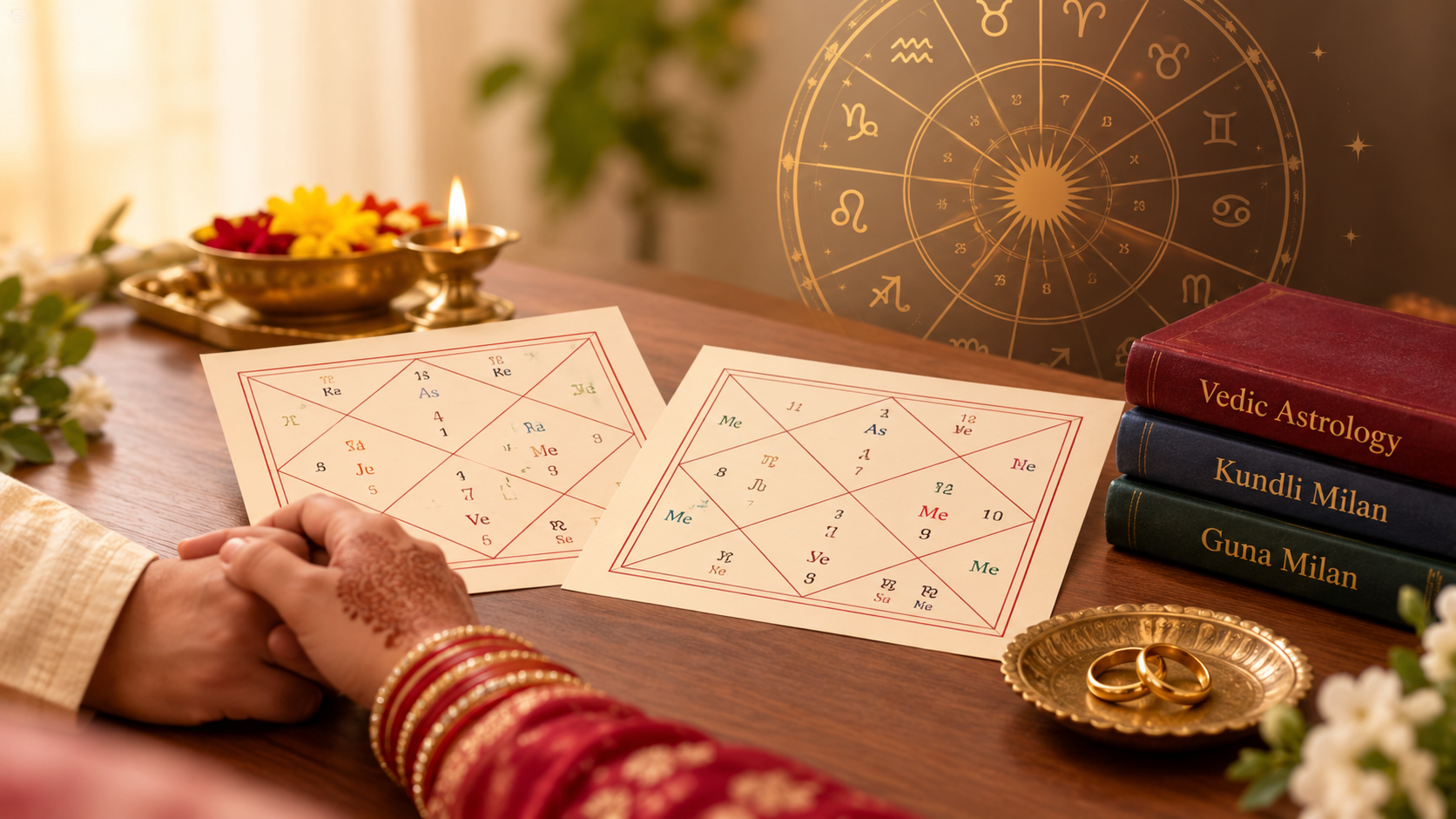
Marriage is one of the most significant milestones in life, and in Indian culture, understanding long-term compatibility has always been a thoughtful process. Long before couples exchange vows, families often turn to Vedic astrology to see how two charts align.
If you have ever heard elders talk about matching horoscopes, you might be familiar with the term Kundli Milan. But marriage compatibility in Vedic astrology goes far deeper than a simple numerical score. It involves looking at psychological alignment, emotional maturity, and shared life goals.
Here is a breakdown of how marriage compatibility is evaluated in Vedic astrology.
What Is Kundli Milan?
Kundli Milan, or horoscope matching, is the traditional process of comparing the birth charts of a prospective bride and groom. The primary goal is to assess how harmoniously two individuals will live together, resolve conflicts, and support each other through life's ups and downs.
While modern relationships rely heavily on shared values and communication, Kundli Milan adds an extra layer of insight by examining the underlying energetic and karmic dynamics between two people.
The Ashtakoot System: The 36 Gunas Explained
The most common method of matching charts in North India is the Ashtakoot system, also known as Guna Milan. This system evaluates compatibility across eight different categories (kootas), adding up to a total of 36 points (Gunas).
Varna (1 Point): Measures spiritual compatibility and ego levels.
Vashya (2 Points): Assesses mutual attraction, influence, and emotional control.
Tara (3 Points): Examines health, well-being, and destiny alignment.
Yoni (4 Points): Evaluates physical and biological compatibility.
Graha Maitri (5 Points): Measures mental compatibility, friendship, and intellectual harmony based on Moon signs.
Gana (6 Points): Analyzes temperament and behavioral nature (Divine, Human, or Demonic).
Bhakoot (7 Points): Evaluates emotional connection, family welfare, and long-term love.
Nadi (8 Points): The most heavily weighted category, examining health, genetic compatibility, and life energy.
Traditionally, a score of 18 out of 36 is considered the baseline for a match. Scores above 24 are viewed very favorably. However, Vedic astrologers emphasize that the numerical score is only the starting point.
Beyond Guna Milan: Why House Analysis Matters
Relying solely on the Guna Milan score is a common mistake. Two charts might score 30 out of 36 points, yet still face challenges if their individual house placements are misaligned.
A thorough marriage compatibility reading also looks at specific houses in the birth chart:
The 7th House: Represents marriage, direct partnerships, and how you treat your spouse.
The 8th House: Governs longevity, intimacy, and shared finances.
The 2nd House: Focuses on family life, speech, and domestic stability.
Mars Placement (Manglik Dosha): Astrologers check the position of Mars to see if it creates energetic imbalances that could lead to friction or frequent arguments in a partnership.
Modern Relationships and Vedic Astrology
Today, compatibility is about much more than traditional matchmaking metrics. Modern couples look for emotional intelligence, mutual respect, and shared ambitions.
When used responsibly, Vedic astrology does not dictate who you should or should not marry. Instead, it acts as a mirror, highlighting potential areas of friction—such as how you handle conflict or manage finances—allowing couples to understand each other's natural tendencies before making a lifelong commitment.
Conclusion
Checking marriage compatibility through Vedic astrology offers a fascinating look into how two distinct personalities interact. While Guna Milan provides a helpful baseline score, examining the deeper house placements and planetary dynamics gives a complete picture of a relationship's potential. Whether you are exploring traditional matchmaking or trying to understand your partner better using an [INTERNAL LINK], astrology serves as a tool for deeper self-awareness and mutual empathy.
Frequently Asked Questions (FAQs)
What is Kundli Milan in astrology?
Kundli Milan is the process of comparing the birth charts of a prospective bride and groom to evaluate their emotional, mental, and physical compatibility for marriage.
What is a good Guna Milan score?
A score of 18 out of 36 is traditionally considered the minimum acceptable match. Scores between 21 and 28 are considered good, while scores above 28 are rated as very auspicious.
Is a low Guna Milan score a sign of a bad marriage?
Not necessarily. Guna Milan is only one part of compatibility analysis. Astrologers also look at the 7th house, overall planetary strengths, and individual maturity, as mutual respect and communication play a massive role in any successful relationship.
What is Manglik Dosha in marriage matching?
Manglik Dosha occurs when Mars is placed in specific houses (1st, 4th, 7th, 8th, or 12th) in a birth chart. It is traditionally believed to bring high energy or assertiveness, which astrologers evaluate to ensure emotional balance between partners.
Can astrology guarantee a successful marriage?
No. Astrology provides a framework for understanding natural tendencies, strengths, and potential challenges. A successful marriage ultimately depends on mutual understanding, effort, emotional maturity, and shared values.